
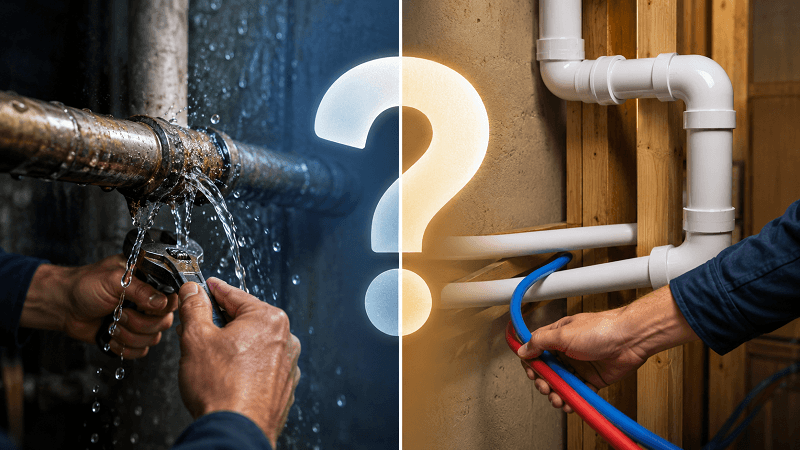
When a plumber finds a leak, the first question isn’t whether to fix it. It’s whether a simple repair will hold, or whether that whole section of pipe needs to be rerouted instead. The honest answer depends on the pipe’s age, its material, and how it failed. A single pinhole leak in a young, well-supported line is usually a quick patch job. A leak in old galvanized steel, or one that’s the second or third failure in the same stretch of pipe, is usually a sign the whole run needs to go. Teams like 0800 Homefix make that call after inspecting the pipe itself, not before, because guessing wrong means paying for the same repair twice.
Repair the pipe when the leak is isolated, the material is still sound, and the surrounding line shows no corrosion or wear. Reroute the pipe when it’s old, corroded, built from outdated material such as galvanized steel or polybutylene, or has already leaked more than once. A short inspection usually settles which category a pipe falls into.
How Plumbers Actually Decide Between the Two
There’s no single rule that applies to every house. A plumber weighs a handful of factors before recommending a fix, and skipping this step is how homeowners end up paying for a repair that fails again within a year.
1. Pipe Age and Material
Copper pipes installed in the last 20 to 30 years usually have plenty of life left, so a repair often makes sense. Galvanized steel, common in homes built before the 1960s, corrodes from the inside out. Once one section fails, nearby sections are usually close behind. Polybutylene pipe, used through the 1980s and 90s, is known to fail without warning and is rarely worth patching at all.
2. Extent and Location of the Damage
A pinhole leak on an accessible, straight run of pipe is simple to cut out and repair. A leak inside a wall cavity, under a slab, or at a joint that’s already been patched before is a different story. In those cases, rerouting the line through an accessible path, like an attic or exterior wall, often costs less than tearing open finished walls or flooring to reach the original spot.
When a Simple Repair Is the Right Call
Repair is usually the smarter choice when:
- The pipe is copper, PEX, or another modern material in otherwise good condition
- This is the first leak in that section of piping
- The damaged area is small and easy to access
- A pressure test shows no weakness elsewhere in the line
- The rest of the plumbing system is under 25 years old
In these situations, cutting out the damaged section and installing a coupling or a new length of pipe solves the problem for a fraction of the cost of a full reroute.
When Rerouting Is the Smarter Long-Term Fix
Rerouting makes more sense when:
- The pipe is galvanized steel, polybutylene, or another material known to fail repeatedly
- The same section has already leaked more than once
- Corrosion or mineral buildup is visible on nearby sections of pipe
- The leak is in a hard-to-reach spot where repeated repairs would mean repeated demolition
- A camera inspection shows scaling or pitting throughout the line, not just at the leak point
Rerouting costs more upfront, but it removes the risk of another leak six months later in a different spot on the same failing pipe.
Repair vs Reroute: Side-by-Side Comparison
| Factor | Repair | Reroute |
| Typical cost | Lower, single fix | Higher, full new line |
| Time to complete | Hours | One to several days |
| Best for | Isolated, recent leaks | Repeated or slab leaks |
| Pipe age | Under 15-20 years | Aging or outdated material |
| Long-term risk | Possible repeat leaks | Lower risk of recurrence |
| Disruption | Minimal | Moderate to significant |
What Leak Detection Experts Look For Before Recommending a Fix
Before recommending repair or reroute, leak detection experts run a few standard checks: pressure testing to confirm the leak’s exact location, moisture meters to see how far water has traveled through walls or flooring, and sometimes a small camera to look inside the pipe itself. Acoustic listening devices can also pinpoint a leak’s location by picking up the sound of water escaping under pressure, which is especially useful when a pipe runs behind tile or concrete.
These tools matter because a visible drip is often not where the actual failure sits. Water travels along joists, insulation, and drywall before it shows up as a stain or puddle, so tracing the true source is what determines whether repair or reroute is the right call.
When the Leak Becomes an Emergency
A slow drip under a sink can usually wait a day for a scheduled appointment. A burst pipe, a leak near electrical wiring, or water actively pooling on a floor cannot. In those situations, calling emergency plumbing services to shut off the water and stop the damage from spreading matters more than deciding on repair versus reroute right away. That decision can wait until the immediate flooding risk is under control.
DIY Fixes vs Calling a Professional
Pipe clamps, epoxy putty, and rubber sleeve repairs sold at hardware stores can slow a leak temporarily, but they’re not a permanent fix and they can hide the real extent of the damage. A patch that looks fine from the outside can still be sitting on a pipe that’s corroded all the way through a few inches away.
For anything beyond a temporary stop-gap, it’s worth bringing in home emergency repair services that can assess the pipe properly, run a pressure test, and give a straight answer on whether a repair will hold or whether the section needs replacing. Guessing on a plumbing repair usually costs more in the long run than getting it right the first time.
Frequently Asked Questions
1. How do I know if my pipe needs to be replaced instead of repaired?
If the pipe is galvanized steel, has leaked more than once in the same area, or shows visible corrosion nearby, replacement or rerouting is usually the better long-term option than a patch repair.
2. Is repairing a pipe cheaper than rerouting it?
Yes, in most cases. A localized repair costs less because it only replaces a short section of pipe, while rerouting involves new pipe runs and more labor.
3. Can a repaired pipe leak again in the same spot?
It can, especially if the surrounding pipe is already corroded or under similar stress. That’s why plumbers check the condition of nearby sections before recommending a repair.
4. How long does a pipe repair typically last?
A well-done repair on a sound pipe can last as long as the rest of the plumbing system, often 20 years or more. A repair on a failing pipe may only buy a year or two.
5. What pipe materials are more likely to need a full reroute?
Galvanized steel and polybutylene are the two materials most likely to need rerouting rather than a spot repair, since both are prone to widespread failure rather than isolated leaks.
6. Does homeowners insurance cover pipe repair or replacement?
Coverage depends on the policy and the cause of the leak. Sudden, accidental damage is often covered, while gradual wear and tear from an aging pipe usually isn’t. Checking the policy directly is the only way to know for sure.
7. How long does it take to reroute a pipe?
Most single-line reroutes take a day or less, though jobs involving wall or floor access can take longer depending on how much needs to be opened up and repaired afterward.
Final Thought :
Deciding between a repair and a full reroute isn’t something to guess at from a wet patch on the ceiling. It comes down to the pipe’s age, material, and history, and that only becomes clear after a proper inspection. Getting it wrong means paying for the same job twice, once now and again when the next leak shows up a few feet down the line.
That’s the kind of judgment call worth handing to someone who inspects pipes for a living rather than making it based on how bad a leak looks on the surface. 0800 Homefix has built its plumbing work around exactly that kind of assessment, checking pipe condition properly before recommending whether to patch it or replace the run, so the fix holds the first time.