
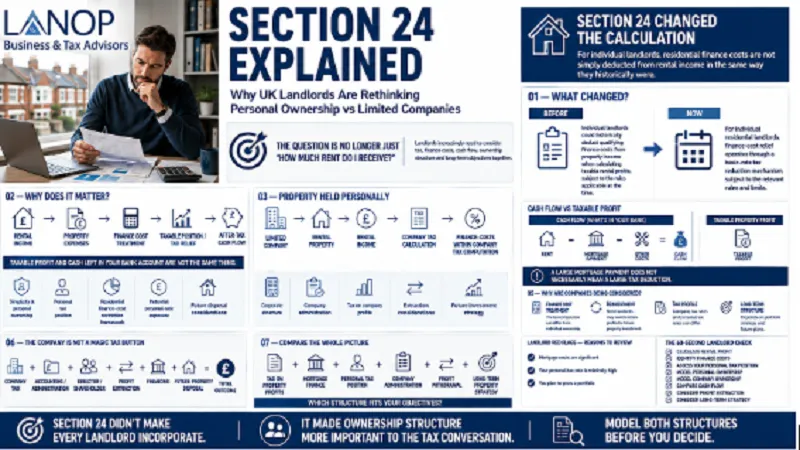
More landlords are calling landlord accountants this year than at almost any point since Section 24 came in, and the question is nearly always the same: should I hold my properties in a company instead of my own name? Section 24 changed the way individual landlords receive tax relief on mortgage interest. For a lot of people, it turned a profitable rental into something that looks profitable on paper but feels tighter in the bank account. Limited-company ownership has become the obvious-sounding fix.
Obvious isn’t the same as correct, though. Mortgage costs, Corporation Tax, the tax on getting money out of a company, admin, and the cost of moving existing properties across all change the maths. Add those up and the answer stops being simple. It depends on your portfolio, your borrowing, and what you plan to do with the rental income.
What Section 24 Actually Changed?
Landlords used to deduct mortgage interest from rental income before working out their tax bill, the same way any business expense gets treated. Section 24 replaced this system with a flat 20% tax credit. The effect: taxable income goes up even though your actual cash position hasn’t, which is why so many landlords feel taxed on profit they never kept.
Say a landlord collects £15,000 in rent, pays £6,000 in mortgage interest, and has £2,000 in other expenses. Before Section 24, taxable profit would have been £7,000. Now it’s £13,000, with a 20% credit applied against the £6,000 of interest afterwards. For a higher-rate taxpayer, that difference is real money, and it can even tip someone into a higher tax band.
None of this is temporary, and none of it is likely to reverse. It hits individual landlords, not companies, and it hits harder the more you’ve borrowed and the higher your tax band.
Why Does Company Ownership Look Attractive?
A company can claim mortgage interest as a standard business expense. No restriction, no tax credit workaround. Rental profit gets taxed through Corporation Tax instead. That’s currently 19% up to £50,000 of profit and 25% above £250,000, with a sliding scale in between.
That’s the appealing headline, and it’s also where a lot of landlords stop reading. Stopping there is the mistake.
The Catch Nobody Mentions: Getting the Money Out
Corporation Tax is only the opening bill, not the final one. Take profit out as a dividend and you pay dividend tax on top of that, currently around 8-9% at basic rate and rising sharply from there. Higher company mortgage costs, accountancy fees, and general paperwork stack on top of that, and the “just 19%” pitch quickly falls apart.
| Factor | Personal Ownership | Limited Company |
| Mortgage interest | Restricted by Section 24 | Fully deductible |
| Profit tax | Personal income tax rates | Corporation Tax, then dividend tax on extraction |
| Reinvesting profit | Comes from taxed personal funds | Company can retain profit before extraction |
| Mortgage market | Wide, mainstream lenders | Smaller, often pricier, specialist lenders |
| Admin | Simple | Accounts, filings, more moving parts |
| Moving existing property in | Not applicable | May trigger CGT and Stamp Duty |
Are Company Mortgages Really Cheaper in Practice?
Rates on limited-company buy-to-let mortgages have narrowed the gap with personal borrowing, but they’re rarely identical. Lenders often want personal guarantees from directors too. The real test isn’t the interest rate on its own. It’s whether the tax saved from deducting interest in full beats the extra cost of borrowing once both numbers sit side by side.
The Question Most Landlords Skip: Do You Need the Money?
Whether you need the money personally is the one factor that actually decides this. Pull rental income out every month to live on, and you’re paying Corporation Tax then dividend tax on the same pound, so the company advantage shrinks fast. Leave profit inside the company to fund the next purchase, and it compounds without a second tax hit, tilting the maths firmly toward the company.
Two landlords with identical properties can land on opposite answers here. One needs the rent to cover their bills. The other is reinvesting everything into growing the portfolio.
Buying New vs Moving What You Already Own
Landlords miss this distinction constantly. Buying your next property through a company is a fresh decision with no baggage. Moving an existing personally-owned property into a company is different entirely; it can trigger Capital Gains Tax and Stamp Duty Land Tax, since you’re effectively selling to a connected party. Incorporation relief exists, but it isn’t automatic.
Common Myths Worth Retiring
A limited company doesn’t mean you “only pay 19% tax.” That’s the Corporation Tax rate, before you’ve touched a penny personally.
Moving an existing property into a company isn’t tax-free either. HMRC treats it as a sale to a connected party, CGT and SDLT included.
Section 24 doesn’t mean every landlord should incorporate. And a higher mortgage rate on a company loan can easily eat the tax saving you were chasing.
When Personal Ownership Still Makes Sense?
Small portfolios, low borrowing, and needing the rental income personally all point toward staying as you are. If moving your existing properties would trigger a CGT and SDLT bill that takes years to earn back, simplicity wins.
When a Company Is Worth Investigating?
Higher-rate taxpayers with significant mortgage interest, landlords growing a portfolio rather than living off it, and anyone buying new rather than moving existing stock have genuine reasons to look closer. None of these factors alone proves a company is right. Together, over a few years of real numbers, they usually point somewhere clear.
Before You Change Anything
Work out your current position first: rental income, mortgage interest, actual cash retained. Then model the company alternative properly, Corporation Tax, likely extraction, financing costs, and the cost of moving any existing property. Compare both over several years, not one tax return, and get advice before you transfer anything.
Frequently Asked Questions
What is Section 24?
It stops individual landlords deducting mortgage interest from rental income before working out tax. Relief instead comes as a flat 20% credit applied afterwards, and it only applies to residential property held personally.
Does Section 24 apply to limited companies?
No. Companies deduct mortgage interest as a normal expense and pay Corporation Tax on what’s left, which is the whole reason company ownership comes up so often in these conversations.
Is a limited company worth it for one rental property?
Usually not. Unless borrowing is high and the income isn’t needed personally, the Corporation Tax and dividend tax combination, plus accountancy and admin costs, tends to outweigh the Section 24 saving on a single, lightly mortgaged property. It makes more sense as the portfolio grows.
Should I transfer my existing rental property to a limited company?
Model it properly first. Moving a property you already own can trigger Capital Gains Tax and Stamp Duty Land Tax, since HMRC treats it as a sale to a connected party, and a good pair of landlord accountants will run those numbers before you go anywhere near it.
Are limited-company buy-to-let mortgages more expensive?
Often, yes, though the gap has narrowed. Rates tend to sit higher than mainstream personal deals, and lenders frequently want personal guarantees too.
Conclusion
It was never “which structure has the lower tax rate.” It’s which structure leaves you with more money once every cost is accounted for. Section 24 makes that worth investigating, but it doesn’t make the answer the same for everyone. If you want that comparison run on your actual numbers, Lanop Business & Tax Advisors can model both routes before you commit.