
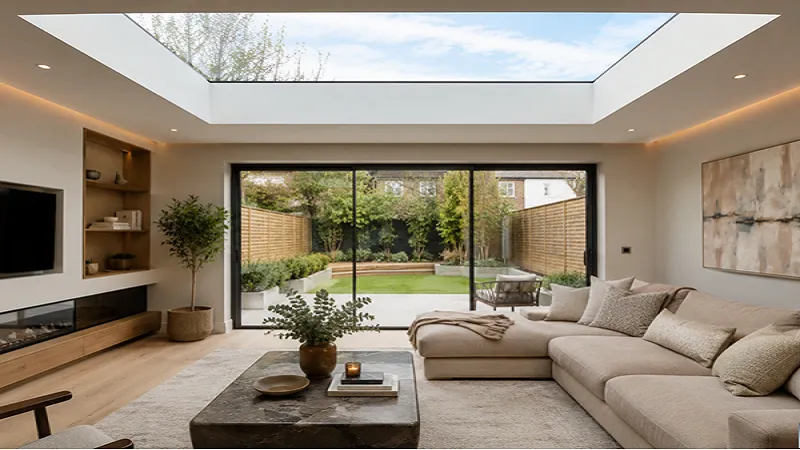
A rear extension can look bright on a drawing. Real life is different. Cabinets go in, a tall fridge takes one wall and the dining table sits where daylight begins to fade. The garden doors still do their job, but the middle of the house can feel dull by breakfast.
Now, if anyone wonders about how a flat roof skylight works differently when comparing it to the typical roof windows, there’s more to define. After all, it tends to bring light straight and from the above as the room doesn’t just borrow daylight from just one end.
Reason 1: Flooding Your Home With Beautiful Natural Ligh
The change is often noticed in ordinary places. The worktop near the old part of the house no longer needs a spotlight at noon. The dining table looks less grey. A hallway beyond the extension may even pick up more light.
Roof glazing works well because fences, sheds and neighbouring walls do not block the sky in the same way they block a normal window. The light arrives from a wider angle. It also shifts during the day, so the room never looks quite the same.
Bigger glass is not always the answer. One oversized unit can throw hard light onto a single area while leaving the rest untouched. Two smaller rooflights may suit a long kitchen better.
A few practical questions are worth asking first:
- Where does the room become gloomy?
- Which worktop gets used most?
- Will afternoon sun hit a television?
- Is there room for a blind later?
Good placement is what makes the light useful. Size on its own does not.
Reason 2: Boosting Your Property’s Value and Kerb Appeal
A bright extension often feels larger than it is. Buyers tend to notice that before the measurements. They may not ask about spacer bars or frame depth. They do notice whether the kitchen feels pleasant to stand in.
A rooflight can give the room a clearer shape. It might sit above the island, pick out the dining area or break up a plain ceiling. When the position follows the layout, the glazing feels as though it belongs there.
The outside view matters too. A bulky frame can make a neat roof look heavy. A lower-profile design usually appears calmer from an upstairs window or the end of the garden.
No rooflight can promise a fixed increase in sale price. Its value comes from improving the room itself. Better light and a more finished look can make an extension easier to enjoy now.
Planning limits, cleaning access and nearby trees should be checked before installation. In addition, the meticulous details may seem small but the first layer says another story. For one thing, the leaves just settle on the glass’s surface.
Reason 3: Improving Energy Efficiency and Reducing Heating Costs
The usual concern is easy to understand. More glass can sound like more heat loss. That was often true of old plastic roof panels. Modern units can perform much better, though the figures still need checking.
Homeowners comparing skylights for kitchen extensions should look at the U-value for the complete unit. Some figures describe only the centre pane. The frame, seals, and kerb matter too.
A lower U-value generally means the unit holds onto heat more effectively. Better daylight can also keep the lights off for longer, which matters in a kitchen used from breakfast through to the evening.
Installation has a large part to play. Gaps around the upstand can create cold edges. Weak insulation may lead to condensation.
To define, this can relate to poor waterproofing because it is a factor that may stay hidden until several days of rain expose it.
On the other hand, there’s the matter of double or triple glazing, low-emissivity coatings, and warm-edge spacer bars, which are worth comparing. Solar control glass can help on a roof that catches strong summer sun. The best option suits the room rather than the highest price.
Reason 4: Enhancing Ventilation and Indoor Air Quality
Firstly, if there’s a matter of the cooking heat, it tends to have a habit of staying put. Furthermore, that is when the whole steam gathers near the ceiling. Food smells drift into the next room. After several pans have been on the hob, the kitchen can feel heavy even when the extractor has been running.
An opening rooflight gives warm air a direct route out. It works at the level where heat collects. A garden door may cool the floor while the upper part of the room still feels stuffy.
Opening models vary. Some use a pole. Others work through a wall switch, remote control or solar-powered motor. Rain sensors can close the unit when the weather changes. That matters when a shower arrives while nobody is home.
A rooflight should not replace a proper extractor fan. The extractor deals with grease and moisture close to the hob. The opening above helps clear the warmth and stale air left behind.
Controls should be easy to reach. On top of that, a more clever feature is not reliable as you are operating it. For you see, it feels like a chore by the end of the day.
Reason 5: Low Maintenance and Long-Lasting Durability
As soon as your everyday flat roof skylight goes through situations.
For one thing, these can involve rain, frost, dust, bird mess and falling leaves. Yet, there is no sheltered side. A well-made unit can still last for years when the surrounding roof work is sound.
The upkeep is usually simple. Leaves should be cleared before they block drainage. The glass needs cleaning once dirt begins to dull the light. Seals deserve a quick look after rough weather. A damp mark near the opening should be investigated before fresh paint hides it.
Self-cleaning glass can reduce the work. It will not remove every mark. Homes near trees, busy roads, or the coast may still need more frequent cleaning.
The installer has a major effect on durability. Correct kerb height, tidy flashing and careful waterproofing protect the opening. Even excellent glazing can become troublesome when those basics are rushed.
A quick check after winter is often enough. Drainage points can be cleared, controls tested and the nearby roof covering inspected. Low maintenance still means occasional care.
Conclusion
A flat roof skylight can solve the dim middle of an extension without taking away useful wall space. The strongest results come from sensible placement, suitable glazing and careful fitting. When those details are handled properly, the room gains something practical every day, not just a feature that looks good in photographs.