
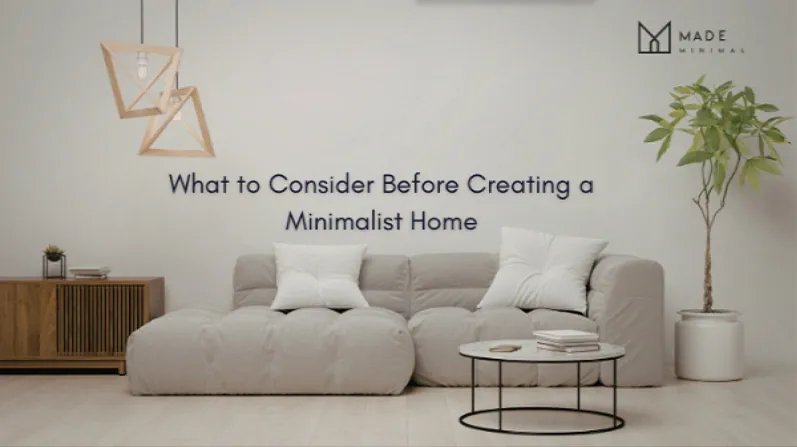
Minimalist home decor starts with keeping what you use and removing everything else. Still, most people get that order backwards. They redecorate first, buy new pieces, rearrange the furniture, and then wonder why the house still feels heavy and cluttered.
The real challenge is knowing what to do first. At MadeMinimal,we see this often. People want to simplify their home but have no idea where to begin, and that missing starting point is what this article covers.
This article walks you through that mindset, the clear-out, the organisation, and the buying decisions that come before anything else. Each one builds on the last, and together they give you a clear path forward.
The Minimalist Lifestyle Begins With the Right Mindset
The minimalist lifestyle starts with asking questions like “Does what you own serve your life?” or “Does it just occupy space?”

The honest answer, for most people, is that a good chunk of what they own just ends up occupying space. And it’s a realisation that can change how you think about owning things.
However, that shift in thinking runs into two common obstacles.
What “Living With Less” Means
Living with less means your home only holds what you use, need, or value. It doesn’t start with an empty room, and you don’t need to get rid of everything you own. Once you realise that, the whole process starts to make sense.
Think of it this way: decluttering without a mindset shift is like bailing water from a boat with a hole still in it. You stay busy, but the water keeps rising.
Why Most Decluttering Attempts Don’t Stick
A clear-out without a change in habits just resets itself. In our experience, the people who bypass the mindset stage nearly always end up back at square one within a month.
According to the Royal Australian College of General Practitioners,clutter affects anxiety levels, sleep, and the ability to focus, and its impact builds over time. So, when the habits behind it never change, a cleared space fills back up before long.
Ultimately, mindset comes before decor. So, getting that wrong means every step after costs more time and money than it should.
What to Let Go of Before You Redecorate
The stuff to let go of before you redecorate falls into three clear categories: unused items, broken things, and pieces kept purely out of habit. Until those go, redecorating just rearranges the problem (that “maybe someday” box never leaves).

That said, it helps to know what each one involves:
- Unused Items: Every drawer, shelf, and corner deserves a look, and anything untouched for over three weeks has no reason to stay. That kind of audit shows you what your home needs before you spend a cent.
- Broken Stuff: That broken lamp you’ve walked past for six months isn’t a future project. Owning things you plan to fix one day slowly adds to your mental load, and that load compounds without you noticing. It’s a huge drain on your mental energy, even if you don’t hear it at first.
- Decorative Items Without Purpose: A shelf full of pieces that do nothing but collect dust pulls your eye in too many directions. Even removing a few of them changes how a room feels when you walk into it.
A lot of what you clear out is still perfectly usable. Luckily for you,GIVIT connects those items directly to Australians in need, so nothing goes to waste. It’s a simple way to limit what goes to the landfill, and it does some good in the world at the same time.
How Home Organisation Sets the Foundation
Good home organisation starts with a dedicated place for every category of item you own. Without that structure, even a well-decorated minimalist home slowly drifts back toward disorder (disorganised minimalism is still stressful).
The thing is, a tidy room without a structure rarely stays tidy. So, once you assign every item a category and a place, you stop losing time searching for things. You also gain more control over how your space looks and feels day to day.
What’s more, surfaces stop becoming dumping grounds, and your home stays clear.
A well-organised room gives you the freedom to focus, and your daily routine gets easier when your home stops working against you. That clarity also makes choosing new pieces much simpler, because you can see what your space is missing.
Simple Living Means Choosing Pieces With Purpose
Every item in a minimalist home should earn its place, and that standard alone changes what you bring into a space.
We’ve watched people follow that approach and immediately want to reassess every room in their house. It’s a small shift in thinking, but it keeps a space from slowly filling back up with purposeless stuff.
A side-by-side look at purposeful and purposeless choices shows what to aim for:
The payoff is a home that needs less tweaking, because every piece earns its place through function, durability, and considered design.
The One Task to Do Before Buying Anything New
Before spending the extra money, audit what you already own. People skip this, buy new pieces, and then wonder why the space still feels off. That gap between buying and knowing is where minimalism loses people.
A good place to begin is one room per week, which keeps the process manageable without losing momentum. The bedroom is a natural starting point, then the living areas, then any shared spaces.
For each item you come across, two questions cut through the noise:
- Do you use it?
- Does it earn its place?
After working through this with hundreds of clients, we’ve found that people walk away with a much shorter shopping list than they started with.
Every item on that shorter list earns its spot before you spend a cent. And because you already know what your space needs, impulse buys don’t stand a chance.
Your Minimalist Home Won’t Build Itself
The stuff you own, how your spaces are organised, and the pieces you choose all influence how your home feels. In fact, approaching them in the right order is what makes the whole process click into place.
This article walked you through the mindset shift, the clear-out process, and building an organisational system. The second half covered choosing pieces with purpose and auditing before you buy. Each one of those steps builds directly on the last.
At MadeMinimal, we stock pieces that are worth adding to your minimalist home. We choose them deliberately and build them to last.