
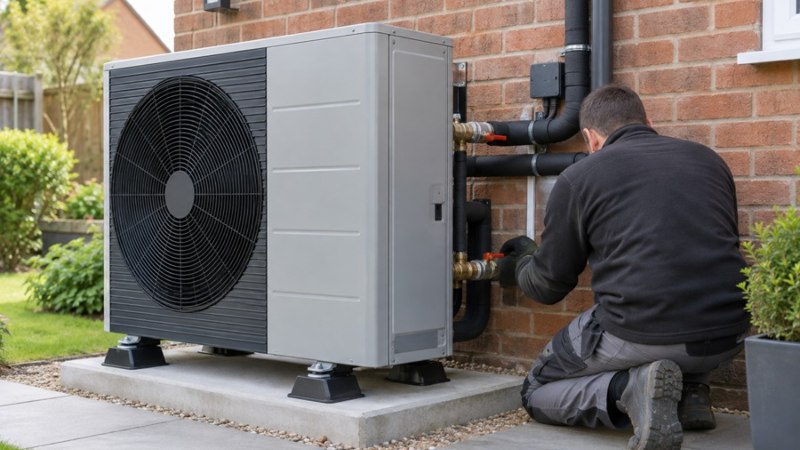
The heat pump has run for a year without complaint. The only reminder that it needs anything at all is an email from the installer about booking the annual visit, arriving in the quiet week before the heating season starts in earnest. Households weighing an air source heat pump price before they sign rarely think that far ahead, yet the twelve months after commissioning are where the quality of the original work becomes visible.
An air source heat pump service is not an optional tidy-up. Manufacturer warranties are normally conditional on a documented annual service carried out by a qualified engineer, which makes the visit a contractual obligation rather than a nicety. Miss two in a row and the warranty is still printed in the folder, but it is no longer worth much. The service record and the commissioning pack are what keep it enforceable.
It is also the most honest report card an installation ever receives.
Where your air source heat pump installation cost shows up years later
The number a household remembers is the one on the quotation. The numbers that govern the next decade are smaller and they repeat. An air source heat pump installation cost is paid once, whereas the annual service, the occasional part and the electricity the system draws arrive every year for as long as the machine is standing in the garden. Most buyers have priced the first and none of the rest. That matters, because the running side is the part an early decision can still make cheaper or dearer long after the invoice has been settled. A well sited, properly commissioned system gets inspected each year, and an awkward one gets investigated.
A proper visit is methodical rather than quick. The engineer works through the system in a fixed order, because each stage explains what he finds at the next one.
- The outdoor unit heat exchanger and its airflow clearance. Leaf litter, a new fence panel and a hedge that has put on a season of growth all show up here, and restricted airflow makes the compressor work harder for the same heat.
- System pressure and the expansion vessel, where a vessel that has lost its charge shows itself as pressure swinging between a cold morning and a warm afternoon instead of sitting still.
- Filters and magnetic filtration, since whatever comes out of the filter is a record of what the pipework has been shedding since the last visit.
- Water quality and antifreeze concentration. Both drift over time, and a diluted antifreeze charge matters on exactly the nights when it is being relied on.
- The refrigerant circuit and the controls. This is the part no owner can check from the outside. It is also the reason the job needs a qualified engineer rather than an afternoon with a hosepipe.
How the air source heat pump installation decides that bill
Every item on that list traces back to a decision taken during the air source heat pump installation, usually in a single afternoon and usually without the householder watching. The engineer who services the system later is reading those decisions one by one.
Siting is the clearest case. The position of the outdoor unit and the clearance left around it are settled on installation day, and they decide how much of a service visit is access work rather than technical work. A unit with room to move around it is cleaned, checked and left alone inside an hour. A unit wedged between a boundary fence and a shed that went up later puts an engineer on his knees with a torch, and the invoice then reflects the time rather than the skill. The same logic runs through the rest of the system. Magnetic filtration fitted at the outset turns the annual filter check into a two-minute job instead of an investigation, and pipework cleaned properly before the pump was ever commissioned leaves that filter far less to catch.
Commissioning paperwork is the other half of it. MCS-certified installations are handed over with commissioning documentation and the design flow temperatures the system was set up around, and the servicing engineer uses those figures as the baseline for judging how it is performing now. Without them, nobody can say whether a system has drifted or whether it was never set up correctly in the first place.
Keep that folder somewhere sensible, because it is evidence rather than admin.
What heat pump installers should record at every visit
The annual visit usually goes back to the company that fitted the system, and that is normally the sensible arrangement. Heat pump installers who commissioned the machine already hold the design figures a service engineer measures against, so nothing has to be reconstructed from the outside. A warranty asks for a qualified engineer rather than one particular firm, but keeping the work in one place keeps the paperwork there too.
What matters more than who arrives is what gets written down. Ask that every visit leaves a written record behind it, setting out what was checked, what was found and the readings taken on the day. Filed with the commissioning pack, that record is the evidence a warranty claim rests on, and it gives the next engineer something to measure against.
A warranty is only ever as strong as the file behind it.
Read in sequence, those records also do something no single visit can. Flow and return temperatures that have drifted apart across three winters say more than the same pair of figures taken once. A filter that fills faster every year points at the pipework rather than at the pump. An expansion vessel recharged in two consecutive seasons is a different matter from one recharged once. None of that is visible to an owner in the garden, and none of it is available to an engineer with no earlier readings to set against today’s. The file is what turns a yearly inspection into a record of how the system changes from one winter to the next.
It is worth saying what that record should contain, because a visit written up as “serviced, all in order” proves nothing three years later.
- The date, the engineer and the qualification the work was carried out under, since the warranty condition turns on that rather than on the visit alone.
- The readings taken on the day, set beside the design flow temperatures from the commissioning pack rather than left to stand on their own.
- What was found and what was done about it, including anything cleaned, topped up, recharged or replaced, and anything noted to watch next year.
Ownership settles into a rhythm after that first visit.
- Before winter. Clear growth, leaves and stored garden furniture away from the outdoor unit, and check that nothing has been built or planted in its airflow since spring.
- Through the season, watch the pressure gauge and listen to the machine, because a pump that has started cycling differently is telling you something worth looking at early.
- After winter. This is the natural slot for the annual visit. The season’s evidence is still fresh and there is no repair urgency behind the booking.
- Every year, file the service record alongside the commissioning documents, since the warranty rests on the two of them together.
None of this makes the equipment cheaper to buy. It makes the difference between a system that is quietly maintained and one that is repeatedly diagnosed, and over fifteen years that difference compounds. The engineer writes the report card either way.